White Horses: The Blend That Wasn’t Meant to Be a Star
White Horses: The Blend That Wasn’t Meant to Be a Star
What Was Not Expected
In the world of pipe tobacco, there are blends whose reputations precede them by years. Their names circulate through forums, settle into wish lists, and when they finally reach the American market, they arrive amid anticipation and noise. White Horses is not one of those blends. Among the offerings of HU Tobacco, it was never particularly front-and-center. It was not one of the blends repeatedly discussed when talk turned to importing HU mixtures from Germany. And perhaps that is precisely the most important thing to say about it:
White Horses was not supposed to surprise anyone — yet it did.
In pipe tobacco, surprise is not a simple concept. It does not merely mean that something tastes better than expected. True surprise occurs when a blend arrives without prior mental baggage and settles exactly into that elusive space the smoker has been searching for — perhaps without even knowing it consciously.
When someone who has praised Director’s Cut for years suddenly says, “This aligns with my palate just one degree more,” we are not dealing with superficial preference. We are witnessing a genuine experiential shift — a discovery. And every discovery carries a certain tension.
On Paper: An Unconventional Composition
Before even opening the tin, the official composition draws attention:
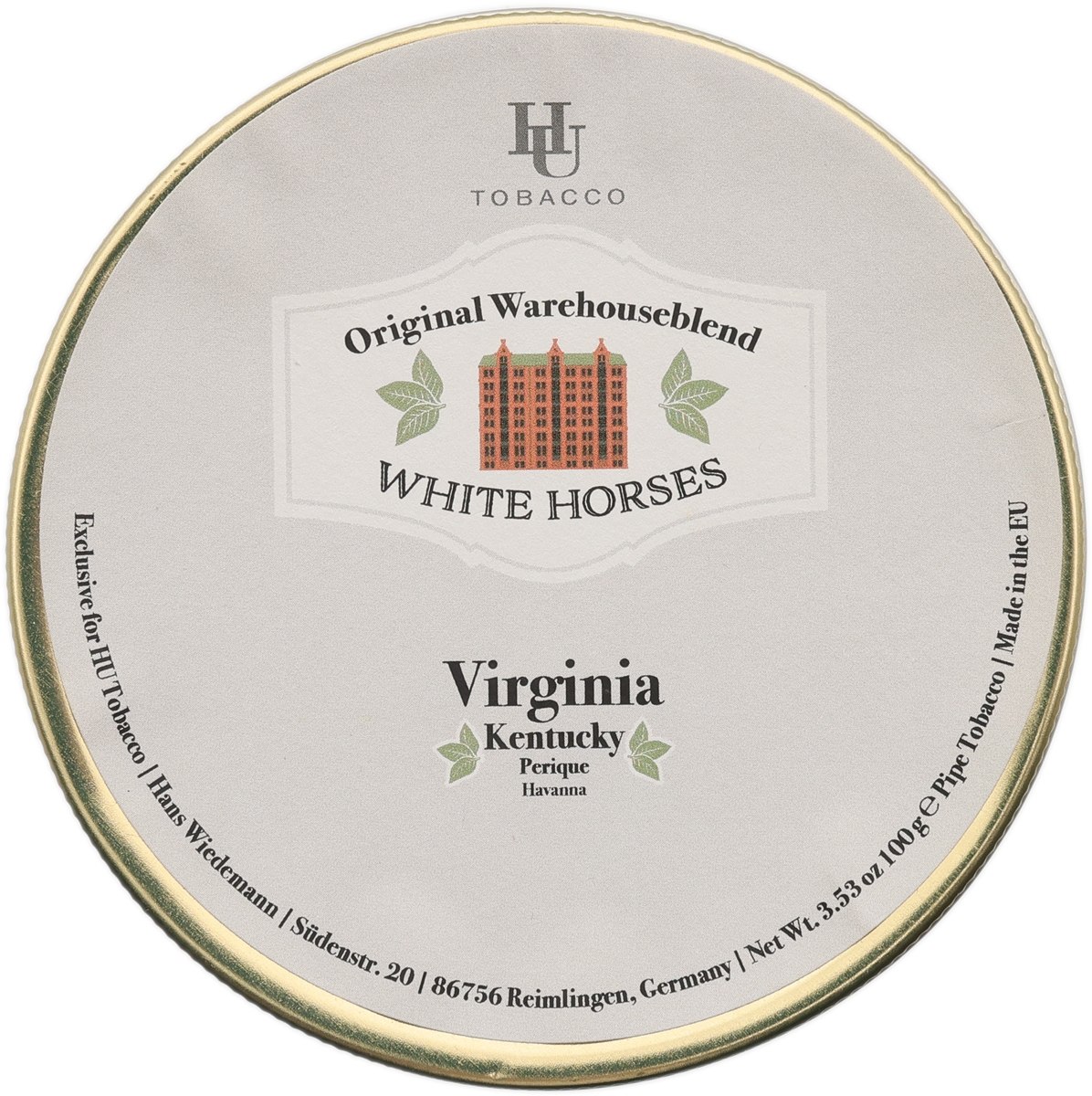
Virginia, Kentucky, Perique, and a portion of Havana leaf.
On paper, this is not merely interesting — it diverges from the standard Virginia blend architecture. And that divergence immediately introduces ambiguity:
What exactly should one expect?
When multiple condimental tobaccos — Perique, Kentucky, Havana leaf — appear together, the key question becomes:
Are they subtle and integrated, or assertive and forward?
Is Virginia the lead voice, with the others acting as shadows?
Or do the condiments step forward, relegating Virginia to structural support?
That ambiguity persists even after the tin is opened — perhaps intentionally so. Uncertainty may, in fact, be part of White Horses’ identity.
Tin Note: First Contact with Complexity
The tin note is the smoker’s first sensory interface. In White Horses, it is vivid, sharp, and distinctly zesty. Aromatics are piquant and stimulating, immediately awakening the senses.
Associations arise:
Dark-fired Kentucky character
A faint resemblance to Toscano cigars
A liveliness reminiscent of Dunhill/Peterson Elizabethan Mixture
Yet none of these comparisons are exact. White Horses resembles them without replicating them. It lives in the space between evocation and imitation.
Two seemingly contradictory layers coexist:
A delicate, almost Italianate floral refinement within the dark-fired character
Earthy, loamy, mushroom-like depth attributable to Kentucky and Perique
Even at the level of aroma, dimensionality is evident.
Within Virginia/Perique blends, two general sensory families often appear:
Dark fruit and pepper-forward profiles
Barnyard funk and zesty vibrancy
White Horses leans toward the latter — earthier and more animated rather than fruit-dominant sweetness.
Physical Cut: Functional Versatility
The cut consists of broken flakes interspersed with fine ribbon strands — effectively a “wild cut.” Medium brown to chestnut hues dominate, with darker fragments throughout.
This is not cosmetic detail. A wild cut offers practical versatility:
Load directly into larger bowls, especially outdoors
Rub out further for smaller pipes or slower burns
Moisture content arrives slightly above ideal but benefits from brief airing. Once adjusted, it packs easily, lights readily, and burns consistently — operational details that distinguish a smooth session from a frustrating one.
Flavor: The Paradox of Complexity and Restraint
From first light, flavor is immediate and abundant. Body: medium. Strength: medium. Flavor intensity and complexity: high.
This creates a tension. Typically, higher flavor density correlates with greater strength or body. White Horses disrupts that expectation.
It does not overwhelm. It does not fatigue. Yet it never feels thin.
A defining quality of exceptional Virginia blends might be described as follows:
A blend that provides comfort and warmth, can recede gently into the background, yet still holds enough intrigue to maintain attention.
At first glance, that is paradoxical. How can something both recede and command focus?
White Horses operates precisely at that intersection.
When smoked casually — while reading, observing scenery — it remains smooth and unobtrusive. But when attention sharpens, slowing cadence and engaging retrohale, layers unfold that were always present but previously unnoticed.
That duality elevates it beyond “merely good.”
Virginia and Condiments: A Moving Boundary
In many Virginia/Perique or Kentucky-influenced blends, either sweetness dominates or spice dominates.
White Horses continually shifts that boundary.
On the palate:
Velvety, pillowy, dense Virginia mouthfeel
Gentle sweetness
On retrohale:
Increasing spice
Earthy depth
Condimental complexity
The palate and the retrohale tell parallel stories — neither canceling the other.
As the bowl progresses, dryness increases slightly. Sweetness remains but is increasingly filtered through earthy tones. Malt-like sweetness appears. Sourdough bread notes — often associated with red Virginias — emerge. A restrained pepper quality develops.
Rather than dark fresh fruit, the profile leans toward raisin — dried fruit rather than juicy plum. A subtle but meaningful distinction.
There is even a moment of self-reflection:
Perhaps “raisin bread” or “raisin bagel” is a constructed metaphor — an attempt to anchor complexity in familiarity.
Such hesitation is not weakness but intellectual honesty in sensory translation.
Strength increases gradually toward the end — medium to medium-full for most smokers.
Comparisons: Coordinates, Not Substitutes
Placed alongside:
Rattray’s Marlin Flake
McConnell’s Folded Flake
Wessex Campaign Dark Flake
Kendall stoved Virginias like Full Virginia Flake or St. James
The purpose is not equivalence, but positioning within a sensory map.
White Horses occupies similar territory — malty sweetness, bowl development, layered depth — without replicating any of them.
Pairing and Timing
White Horses performs particularly well later in the day when the palate is fatigued. Many lighter Virginias lose nuance under such conditions; this blend does not.
It pairs effectively with:
Black coffee
Strong beverages
It neither collapses beneath them nor overwhelms them.
Aging Potential
Prediction:
It should age well.
Complexity is expected to remain intact, with sweetness developing over time — consistent with high-quality Virginias.
Yet an open question remains:
Will increasing sweetness preserve the delicate equilibrium between Virginia and condiments — or tilt it toward a simpler sweet Virginia profile?
Only time will answer.
Final Reflection
White Horses may be — perhaps — the most compelling HU blend encountered thus far.
The qualifiers matter:
“Perhaps”
“So far”
Judgment remains ongoing.
White Horses was not expected to be a star. It carried no hype. And in that absence of expectation, it was free to speak for itself.
Sometimes the most authentic discoveries occur when a blend you did not seek becomes precisely what you did not know you were looking for.